The Importance of Breast Massage

Your whole self is important to consider in your care, every part of you contributes to the experience of your wholeness.
The parts we walk around with and a deep honouring for the parts of us that have changed or that we have lost over the years. I am learning this more and more as time passes.
My intention in writing this piece is to share some insight and reflection on the consideration of a part of our bodies that is often neglected in our care, our breast health.
Statistics show that many people experience breast discomfort at some point in their lifetimes, and that the number that will report this pain to their primary care giver, or to anyone, is quite low. Perhaps because breasts don’t often receive healthy attention or the level of importance in a person’s overall care that they deserve. Breasts are sometimes seen as a “taboo” topic, often sexualized rather than respected, which may contribute to a decreased sense of confidence in voicing any concerns a person may have about their breasts.
Independent of gender, breast tissue is a part of all bodies, completely unique to each of us depending on the anatomical body we were born into, the impact of potential concerns and pathologies we experience, surgical removal, as well as the many transformations we undergo through our lifetime.
As I mentioned, breasts are often neglected in our overall care, sometimes not even considered until we are faced with a problem or pain specific to these tissues or the surrounding area. Our breasts may evoke many different emotions, which needs to be honoured when we start to tend to this part of our bodies.
I wonder how you feel reading these words.
I invite you to take a moment to reflect, perhaps bring your hands to your heart and welcome in a few deep breaths. Notice how you feel and thoughts that may be arising.
Our breast tissue is located in the front of our chest cavity and in many bodies extends into our armpits, anatomically adjacent to our heart and lungs. This is the part of us that is energetically associated with compassion and love, as well as shame, grief, and sadness.
Every time we take a breath our breasts are affected by the movement in our chest wall. Did you know that the muscles of respiration (of breathing) are the same muscles which directly affect your breast health and the ability for the breasts to drain effectively.
Breath and postural patterns through the neck, chest (upper thorax), back and shoulders are some of the primary areas we need to assess when we start to consider ways we can offer ourselves care for our breast health.
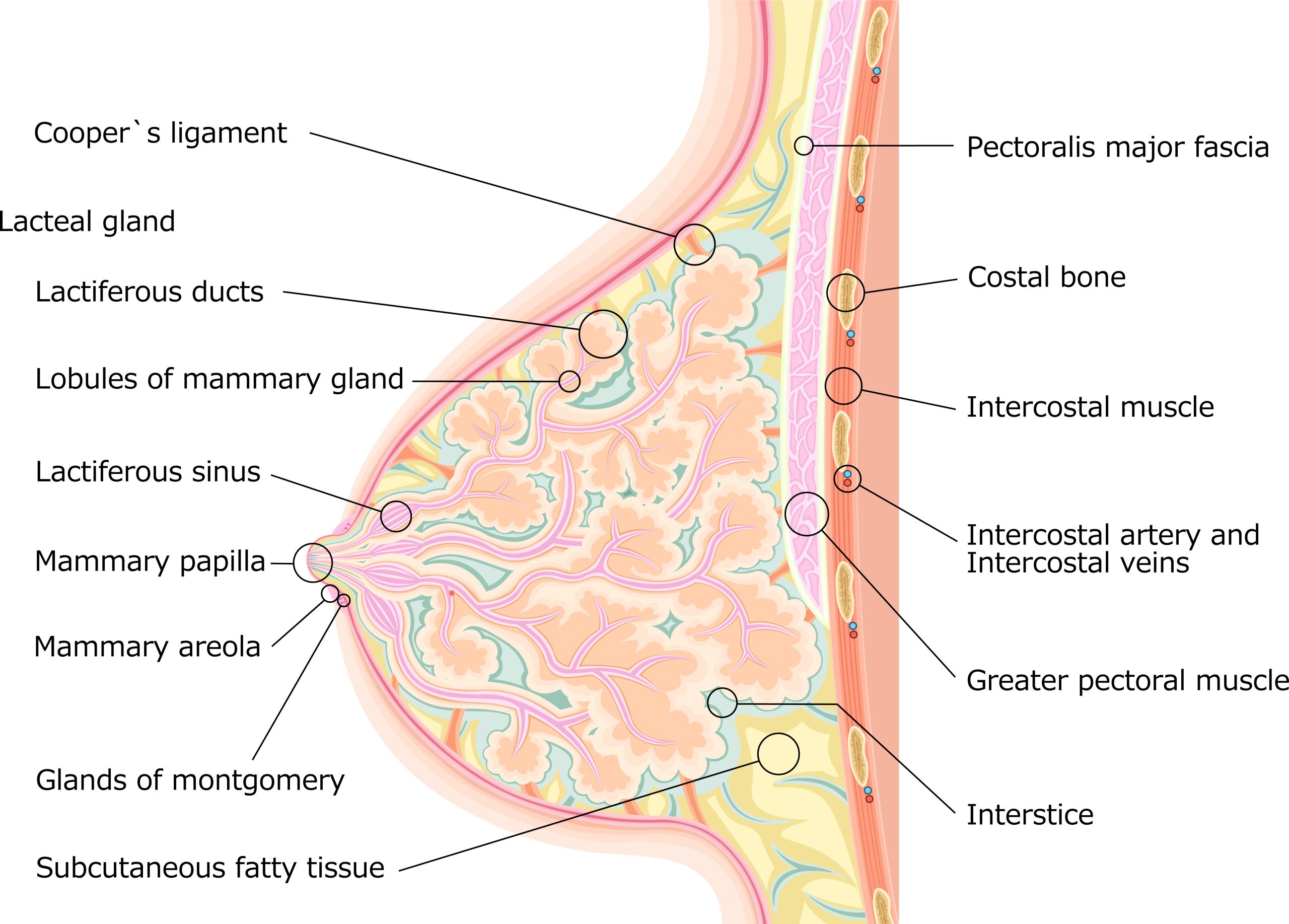
Breast Anatomy
In an anatomical body that is female, breasts have the potential to feed and nourish life. They contain an intricate system of ducts and glands which have the potential in many bodies to create milk for our young. Breasts are also comprised of the areola (or nipple) as well as lymphatic tissue, circulatory vessels, fascia and ligaments, which support the breast tissue.
When learning about our breasts, it’s also important to acknowledge the retromammary space, an important consideration which is located between the more superficial breast tissue and the underlying pectoral muscles (one of our primary chest wall muscle groups). This space is significant in the drainage pathway for our lymphatic system woven through our breasts. This space has a rich source of lymphatic nodes and vessels helping to cleanse and detoxify breast tissue. As you can imagine, this is very significant in reducing congestion and the overall health and mobility of breasts.
In our forward motion world, the muscles located in the front of our chest wall are often quite tight and tend to be restricted creating compression in the retromammary space as well as potentially compressing the circulatory vessels and nerves that support the breast tissues. Tight fitting clothes and binding the breasts can also create further compression, increasing the chance of developing pain, swelling, and discomfort within or around the breast tissue and upper thorax.
Breasts, like all the parts of our bodies, are unique for everyone in the way they grow, change over time, experience different concerns, and how each of us is impacted by all these considerations. We are not carbon copies of each other, everyone’s lived experience is completely unique.
Breasts are susceptible to various changes which are a natural part of our life cycle, as well as supportive personal changes.
These changes can necessitate our need for extra care over our lifespan. Some of which include:
- The menstrual cycle
- The natural process of aging and associated changes (referred to as involution)
- Dietary changes (which changes through our lifetime)
- Gender affirmation surgery
- Transition Related Surgery (TRS)
- Breast reductions and enlargements
- Menopause
- Pregnancy (both during and after)
- Breastfeeding
- Environmental stressors
- Emotional stress
- Surgeries
- Malignant conditions, such as cancer
- Diagnostic procedures
- Trauma
- Benign conditions
Breast cancer, as well as other breast conditions, are becoming more and more prevalent. It is vitally important for us to respect the needs of our breasts and to become more comfortable in exploring and caring for this sacred part of our bodies. I think it’s important to explore touch in a healthy and therapeutic way.
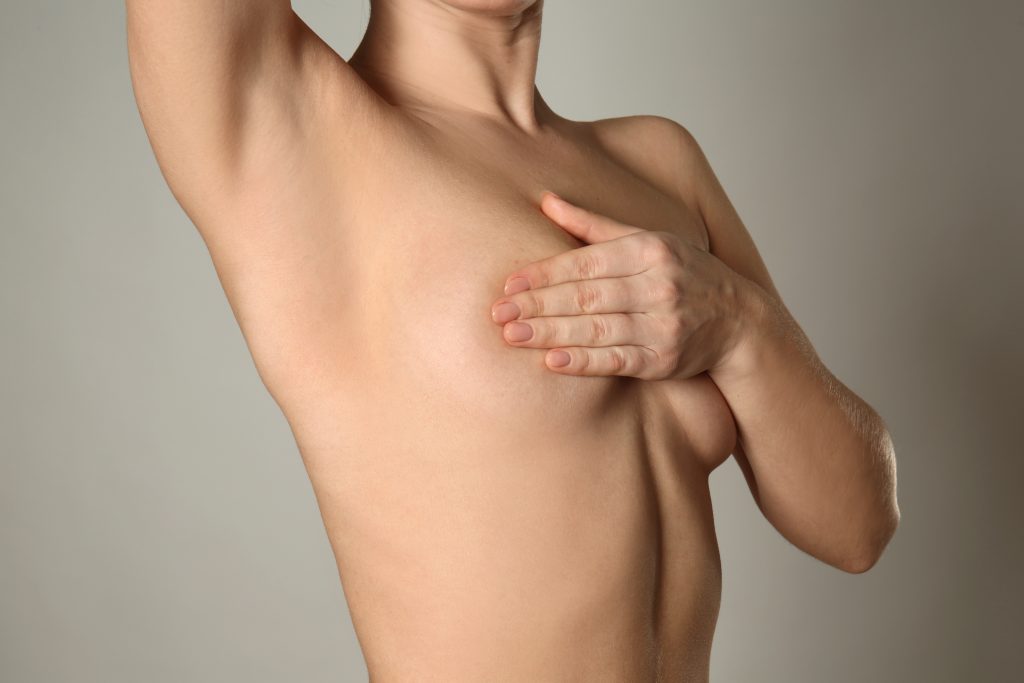
Why massage your breasts?
- Massage can intentionally support both the blood circulation and the lymphatic circulation of breast tissue and for the whole body. Blockages in overall circulation, (due to various causes such as scar tissue, postural patterns, and muscular tightness to name a few) can contribute to swelling and discomfort experienced in the body.
- Folks that have undergone breast surgery (either due to breast reduction, enlargement, lumpectomy, mastectomy, gender affirmation surgery, or other indications for surgery) experience various degrees of pain and other changes as a result of the procedure. Massage can work specifically with scar tissue helping in various ways. Massage has the potential to; improve the health of scar tissue and surrounding structures, improves the movement between tissues reducing adhesions, can help to reduce resultant pain, increase range of motion, can reduce swelling, and gives your body the opportunity to receive care post trauma – on a physical and emotional level. Speaking to an emotional level, massage may offer support as you integrate changes in your physical body and has the potential to create space to release trauma in your tissues – helping you to heal on all levels.
- Breast massage supports regular breast assessment/examination, either by yourself through self-massage or working with a trusted, trained and experienced therapist. It helps to provide another way of monitoring for changes in the breast, including healthy changes. Offering yourself massage allows you to get to know your breasts, so you are more aware of changes when/ if they happen.
- Including your breast tissue as part of your overall health care – healthy breast massage
- Breast massage can also help to heal emotions and societal perceptions of this very sacred area of our bodies and the consideration of its’ care. Past trauma, emotional holding patterns, disease, or simply not having had the opportunity to safely explore the needs of our breasts can disconnect us from our wholeness.
There are many other reasons why breast massage is important, specific to you, the individual. Your breasts are a part of your body, a life nourishing part, that are as deserving of care as every inch of you, it’s never too late to establish healthy breast practices.
Take a moment now and close your eyes. I invite you once again, to bring your hands to your heart or your breasts and take a deep breath to connect. Take another deep breath to ground yourself. It might be helpful to take a third deep breath and just notice what arises. In this pause I encourage you to send a message to your body, a supportive message – one you know intuitively YOU need to hear in this moment. I wonder if you are able to offer it to yourself on a wave of love, reverence and compassion.
Some Breast Massage Guidance
I invite you to join me for this 22-minute video to learn more about self breast massage.
In addition to the video, I have described the key movements for self breast massage below:
- Start with as many slow deep breaths as feels supportive.
- Rest your hands on either side of your neck and with gentle stroking, invite a downward and inward motion (towards the junction between your clavicle and sternum) Repeat 15 X, this helps your body to prepare and to receive the lymphatic fluid as it moves through the tissues.
- Place the palm of your hand in your underarm and gently pump your armpit, stimulating the axillary (armpit) lymph nodes. Bring gentle pressure in towards the body and release the pressure between each pumping motion. The movement is up and in and is ideally slow and gentle - towards your shoulder and in towards your body (I recommend doing this 15 times on each side).
- With your hands cupped around your breast, gently move your breast away from your chest wall and invite in a circular up or down motion to the tissue. This allows the breast generated lymph fluid to drain into the retro mammary space (which we talked about earlier) and out to the axilla (armpit). This also releases tension between your breast tissue and the underlying tissues.
- Relax your hands and use the flat surface of 3 to 4 fingers to make small semi-circles around the outer part of your breasts working inwards until you reach the areola. Do not press hard – this is VERY gentle work. Remember our breasts do not have muscles, stay focused on the lymphatic quality of the work, think about drainage being your priority. You want to move through the whole circumference of your breast – like spokes on a bicycle tire. When considering the depth of pressure - think about the pressure you would use on an infant or a small delicate kitten.
- When you’ve moved around your whole breast, repeat step 4. Now gently direct drainage of breasts towards armpits and midline of the chest (away from the areola).
- Repeat step 4 - With your hands cupped around your breast, gently pull your breast away from the chest wall and move your breast in a circular up or down motion.
- Repeat on the other side of your body.
- Follow massage with some gentle movement of your shoulders and chest stretches.
Remember your muscles of respiration are the same muscles we consider with our breast health, so breathing fully in your body greatly helps to support the massage.

Amber is a Registered Massage Therapist, Registered Yoga Teacher, Cancer Survivor and Breast Health Educator. After a personal sabbatical from her professional work and having received outstanding care at the Centre for Health Innovation during her own cancer journey (2022/23), she knew joining the Centre was a natural way forward to offer compassionate and respectful care with a dedicated team.
Amber is offering a Personalized Breast Massage Program which includes four, 90-minute sessions. She recommends two-week intervals between sessions, or once a month.
References
- The complete Natural Medicine Guide to Breast Cancer; a practical manual for understanding, prevention and care – Sat Dharam Kaur.
- Breast Massage – Debra Curties.
- Medicine Hands; Massage therapy for people with cancer – Gayle MacDonald.
- Program Notes – Massage Therapy and Cancer Considerations - Intensive Study with Tracy Walton (2001, 2005, 2007).
- Program Notes – Healthy Breast Program Certification – 12 week intensive study, essays and exam completion: with Sat Dharam Kaur (2020).
- Atlas of Human Anatomy – Frank Netter
CHI Services
All Services
Supportive Cancer Care
Naturopathic Medicine
Acupuncture & TCM
Integrative & Functional Medicine
Nurse Practitioner Care
IV Therapy
Psychotherapy & Counseling
Grief Support
Hypnosis & Life Coaching
Yoga Therapy
Physiotherapy & Lymphatic Therapy
Osteopathy
Reflexology
CranioSacral Therapy
Massage Therapy
Nutritional Support & Meal Plans
Fees & Schedules
Please see our online booking site regarding fees and schedules.
Recent Blogs
Playback Theatre Fundraiser in Support of Fear of Cancer Recurrence & Progression Program – Friday, May 22
May Spring Find Us