Is Exercise an Effective Treatment for Depression

October 10th was world mental health day, a day to raise awareness of mental health issues around the world. Mental health is important every day of the year, as our emotional wellbeing is essential for handling daily challenges and maintaining a balanced life. Major depressive disorder (commonly called depression) is one of the most common mental health disorders, affecting almost 8% of adults in Canada and over 300 million people worldwide. (1,2) Depression is closely related to, and affected by, physical health. It can make other symptoms and conditions feel worse, such as anxiety, cancer, and heart disease. (3) Exercise has long been known to help people with depression and is included in many treatment guidelines; (4) however, there is no clear guidance on the optimal type or amount of exercise. This is drastically different from other established treatments like antidepressants (e.g., selective serotonin reuptake inhibitors or SSRIs) and cognitive behavioural therapy (CBT), which have very specific prescriptions and recommendations.
This blog provides an overview of the paper: Effect of exercise for depression: systematic review and network meta-analysis of randomized controlled trials. (5) Words in bold are defined below.

To find the best type and amount of exercise, researchers conducted a meta-analysis, which combines information from similar studies to determine an average effect size. The analysis included 218 randomized controlled trials (RCTs) with 14,170 total patients.
Which studies were included?
To be included in the analysis, a study had to meet each of the following criteria:
- The study had to be an RCT
- Participants must have met the criteria for major depressive disorder
- The study had to evaluate exercise as a treatment. Exercise was defined as planned, structured, and repetitive bodily movement done to improve or maintain one or more components of physical fitness
- Exercise regimens had to be at least one week long
Importantly, researchers conducted what is known as a network meta-analysis. This type of analysis allows researchers to compare multiple treatments simultaneously, as long as they included an exercise component. With the network meta-analysis, researchers compared exercise to standard controls (i.e., people who did not exercise) and against established treatments, such as CBT and SSRIs.
What was the quality of the studies included?
Of the 218 studies included, 1 had a low risk of bias, 152 had a high risk of bias, and 65 had an unclear risk of bias. Although this seems poor, it’s important to consider the context of these results. Participant and researcher blinding (i.e., not knowing what group participants are in) is always considered when determining the risk of bias of RCTs. If one element of a study has a high risk of bias, the entire study must be labelled as high risk of bias. In studies involving exercise, blinding participants or staff is not usually feasible, or even appropriate, which causes risk of bias scores to be high. Although the authors had to reduce the certainty ratings of their results due to the lack of blinding (and thus high risk of bias scores), the authors state that their results were unaffected by any risk of bias criteria, based on the results of a sensitivity analysis they conducted, and mention that the risk of bias was likely overestimated.
What were the results?
Many forms of exercise showed benefits for depression
The figure below, taken directly from the paper, shows the different effect sizes (“Hedges’ g”) of various treatments. The purple diamonds show the estimated effect sizes, and the lines on either side show how confident the researchers are in their results. The farther to the left, the larger the effect size. The larger the line on either side, the more uncertain the researchers are in their results. Anything to the left of the pink dotted line represents a clinically important benefit. Take a look at the paper if you want to learn more about this figure and see other visual representations of the data.
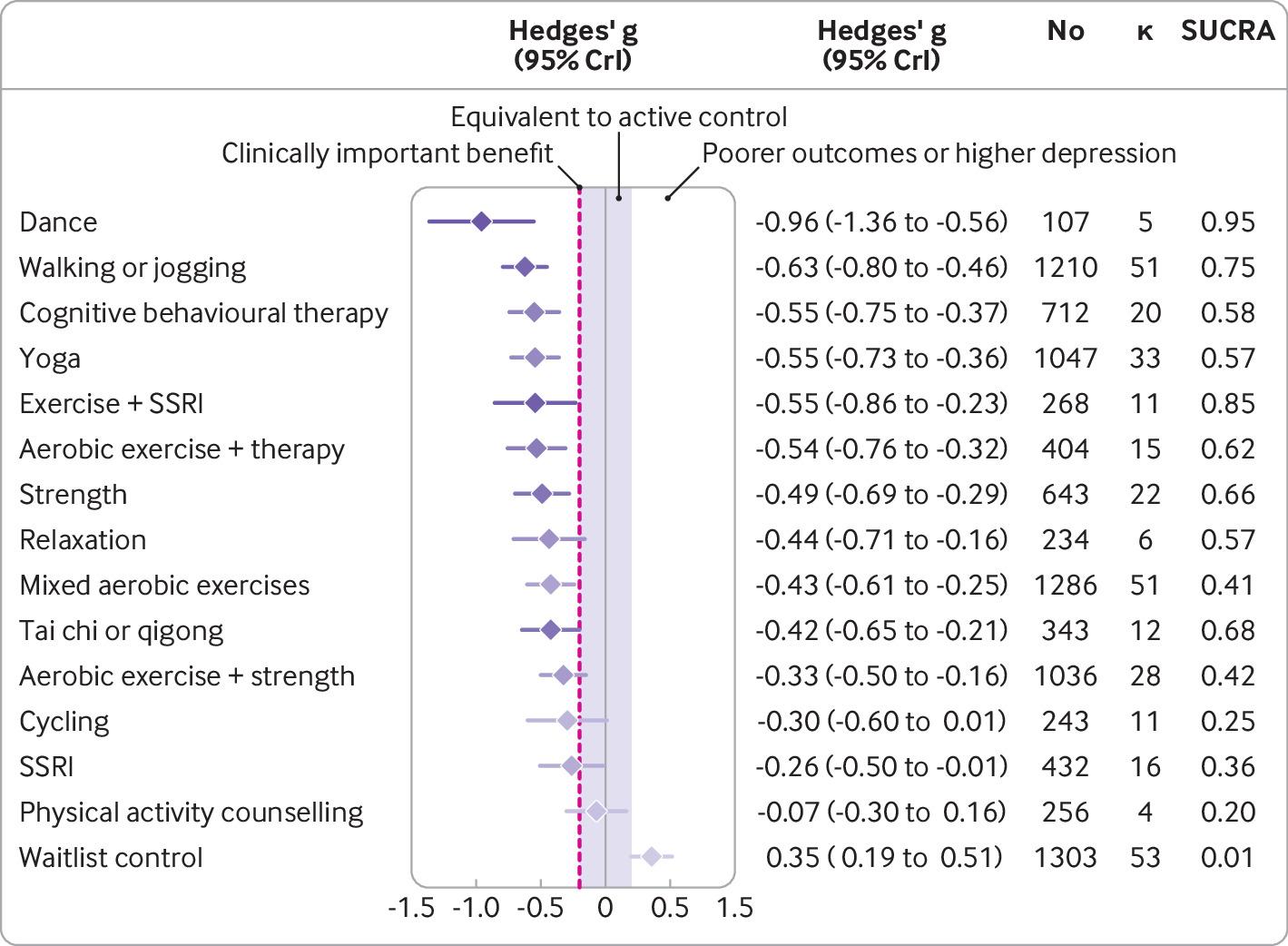
Image source: Figure 4 from the paper “Effect of exercise for depression: systematic review and network meta-analysis of randomized controlled trials” (5)
Depression was improved in people who engaged in dance, walking or jogging, yoga, strength training, mixed aerobic exercises, and tai chi or qigong. Dance, exercise combined with SSRIs, and walking or jogging were most likely to perform best.
Age and sex may be important factors
Larger effects were seen in women for strength training, and in men for yoga, tai chi, and aerobic exercise combined with psychotherapy. Yoga was more effective for older adults, whereas strength training was more effective for younger people.

The higher the intensity, the greater the benefit
Across almost all types of exercise, the benefits increased with a higher intensity. Although light exercise, such as walking and hatha yoga, still provided benefits, activities such as running and interval training had much larger effects. These results were the same regardless of how severe a person’s depression was when they joined the study.
More freedom resulted in less benefits
Interestingly, in studies where patients had more choice in the type of exercise or exercise program, the effects were weaker. The authors do not fully understand why this is, but they think it could be a combination of factors:
- People with depression may benefit from a clear prescription
- More freedom could result in patients being less likely to engage in vigorous activity
- Patients likely only joined studies which interested them, so more freedom within the study may not have been as impactful
What are the conclusions?
The authors conclude that exercise could be considered alongside other established interventions as a core treatment for depression. This review showed that various types of exercise are effective, such as walking, jogging, strength training, yoga, tai chi, and qigong. The benefits of exercise seem to be linked to the intensity of exercise, with more vigorous activities producing the best results. Inherent factors, such as age and sex, may also influence outcomes. Some forms of exercise seem to outperform SSRIs and/or have similar benefits to CBT, which could make exercise a viable alternative to these treatments in certain situations. For example, the inclusion of exercise as an option for depression could reduce some of the fears of drug side effects or engaging in therapy. It also provides a lower cost option, which is especially important for people in low- and middle-income countries.
Should everyone with depression exercise?
Although it is generally recommended for most people to exercise, you should speak with your healthcare provider about exercise as a treatment option for depression. Your values and preferences are an important part of your treatment plan, and while certain forms of exercise could be beneficial for some or even most people, they will not be beneficial for everyone. Ideally, an exercise professional should be involved to ensure the prescription is safe, personalized, challenging, and supported.
Resources
General Fitness
- Nike Training Club: https://www.nike.com/ca/ntc-app
- Cancer FIT+: https://www.cancerfit-plus.com/subscribe
Yoga
- Yoga with Adriene: https://www.youtube.com/user/yogawithadriene
- Yoga with Tim: https://www.youtube.com/@yogawithtim
- Down Dog App: https://www.downdogapp.com/
Running
- Strava: https://www.strava.com/
- Nike Run Club: https://www.nike.com/ca/nrc-app
CHI Practitioners
- Yoga Therapy: https://thechi.ca/yoga-therapy-general-services/
- QiGong: https://thechi.ca/qigong/ Try one class for free!
- Gentle Yoga: https://thechi.ca/yoga-and-meditation/ Try one class for free!
Definitions
Cognitive Behavioural Therapy (CBT): A form of psychotherapy that tries to reduce symptoms of various mental health conditions, primarily depression. CBT is structured and goal-oriented, focuses on current problems, and helps to identify and change unhelpful patterns of thinking and behaviour.
Effect Size (Hedges’ g): Effect size tells you how much one group differs from another. A value of 1 indicates the two groups differ by one standard deviation. Typically, an effect size of 0.2 is considered small, 0.5 is considered medium, and 0.8 is considered large.
Network Meta-Analysis: a statistical technique that allows for the comparison of multiple treatments simultaneously by combining both direct and indirect evidence from RCTs. It allows researchers to estimate the effects of all treatments within the network, even if they have not been directly compared in individual studies.
Selective Serotonin Reuptake Inhibitors (SSRIs): A drug class of antidepressant medication. SSRIs are the most prescribed antidepressant.
Sensitivity Analysis: A way to determine how changes in one thing affect something else in a system or model. It helps determine the uncertainty of a particular outcome depending on various factors.

Mark is a full-time clinical trial coordinator with the Patterson Institute for Integrative Oncology Research. He is involved in the development, implementation, day-to-day activities, and publication of all clinical research conducted at the CHI. Mark joined Dr. Dugald Seely, ND’s research team in 2018 after volunteering with his brother, Dr. Andrew Seely, at The Ottawa Hospital. Mark is also an employee of The Ottawa Hospital Research Institute, a Certified Clinical Research Professional (CCRP), and an active member of the Ottawa Health Sciences Network Research Ethics Board.
References
- World Health Organization. Fact Sheet - Depressive Disorder (Depression). 2024-10-15, https://www.who.int/news-room/fact-sheets/detail/depression
- Statistics Canada. Mental Disorders and Access to Mental Health Care. 2024-10-16, https://www150.statcan.gc.ca/n1/pub/75-006-x/2023001/article/00011-eng.htm
- Rugulies R. Depression as a predictor for coronary heart disease. a review and meta-analysis. Am J Prev Med. Jul 2002;23(1):51-61. doi:10.1016/s0749-3797(02)00439-7
- Kennedy SH, Lam RW, McIntyre RS, et al. Canadian Network for Mood and Anxiety Treatments (CANMAT) 2016 Clinical Guidelines for the Management of Adults with Major Depressive Disorder: Section 3. Pharmacological Treatments. Can J Psychiatry. Sep 2016;61(9):540-60. doi:10.1177/0706743716659417
- Noetel M, Sanders T, Gallardo-Gómez D, et al. Effect of exercise for depression: systematic review and network meta-analysis of randomised controlled trials. BMJ. 2024;384:e075847. doi:10.1136/bmj-2023-075847
CHI Services
All Services
Supportive Cancer Care
Naturopathic Medicine
Acupuncture & TCM
Integrative & Functional Medicine
Nurse Practitioner Care
IV Therapy
Psychotherapy & Counseling
Grief Support
Hypnosis & Life Coaching
Yoga Therapy
Physiotherapy & Lymphatic Therapy
Osteopathy
Reflexology
CranioSacral Therapy
Massage Therapy
Nutritional Support & Meal Plans
Fees & Schedules
Please see our online booking site regarding fees and schedules.
Recent Blogs

Playback Theatre Fundraiser in Support of Fear of Cancer Recurrence & Progression Program – Friday, May 22

May Spring Find Us